A certificate of optimality, and an agent that earns it
A block decomposition splits a domain into quadrilaterals, and it is judged largely by how many of its vertices are irregular. For every domain there is a floor on that number, fixed before any mesh exists. We train an agent to reach it.
The bound: par
The discrete Gauss–Bonnet identity fixes a lower bound on irregularity from the domain's corner angles and topology alone. A mesh that reaches it is provably optimal in its connectivity.
An agent on the half-edge mesh
Starting from the bare boundary, the agent inserts chords and vertices on a doubly connected edge list. Its convolutions follow next, previous and twin, so it runs unchanged on domains larger than any seen in training.
Cloning past a sparse reward
Random play almost never reaches par. Optimal meshes that are trivial to construct, walked backward into demonstrations, get PPO started; PPO on generated domains takes it from there.
Watch it mesh, one move at a time
Shaded faces are not yet quadrilaterals. Dots mark the irregular vertices of the finished mesh; on the curved domain they are exactly the three its corners force.
Single greedy rollouts of the released agent. The tables below use the paper's full evaluation procedure.
Fewer irregular vertices, at the same element count
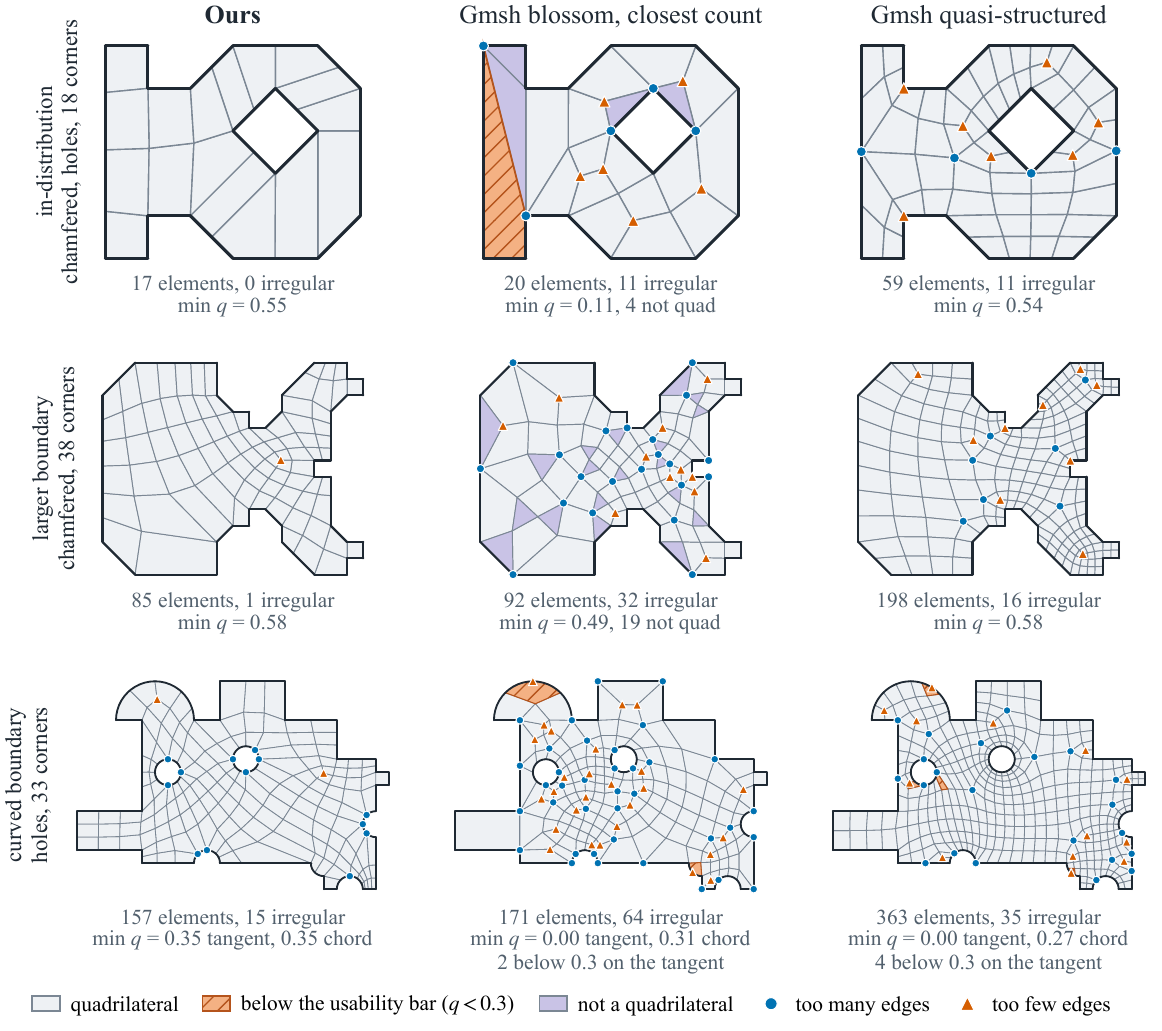
On the same domains, Gmsh's meshers leave many irregular vertices (the dots) even when they are allowed several times the elements. The agent's meshes are at or near the bound.
Top: an in-distribution part with a hole, which the agent meshes optimally. Middle: a domain twice the training size. Bottom: a curved domain with holes, never seen in training.
Held-out mechanical parts
Counts are domains. Excess is the median number of irregular vertices above par; at par counts domains meshed provably optimally.
96 domains, 8–24 corners
| Method | all-quad | usable | excess | at par |
|---|---|---|---|---|
| Gmsh blossom | 51 | 38 | 9 | 0 |
| Gmsh frontal-quad | 43 | 29 | 8 | 1 |
| Gmsh quasi-structured | 96 | 96 | 7.5 | 2 |
| Gmsh blossom-full | 96 | 96 | 26 | 0 |
| Ours | 96.0 | 95.7 | 0 | 90.2 |
64 domains, 25–50 corners
| Method | all-quad | usable | excess | at par |
|---|---|---|---|---|
| Gmsh blossom | 26 | 18 | 39 | 0 |
| Gmsh frontal-quad | 15 | 14 | 34 | 0 |
| Gmsh quasi-structured | 64 | 60 | 22 | 0 |
| Gmsh blossom-full | 64 | 64 | 156 | 0 |
| Ours | 64.0 | 62.0 | 0.75 | 31.0 |
Gmsh blossom and frontal-quad run at our element count; quasi-structured and blossom-full at their natural sizes, 3–15× ours. Ours: five attempts per domain at a doubled move budget with a split-and-continue repair, averaged over evaluation seeds. Curved-boundary results and full tables are in the paper.
Optimal meshes, walked backward
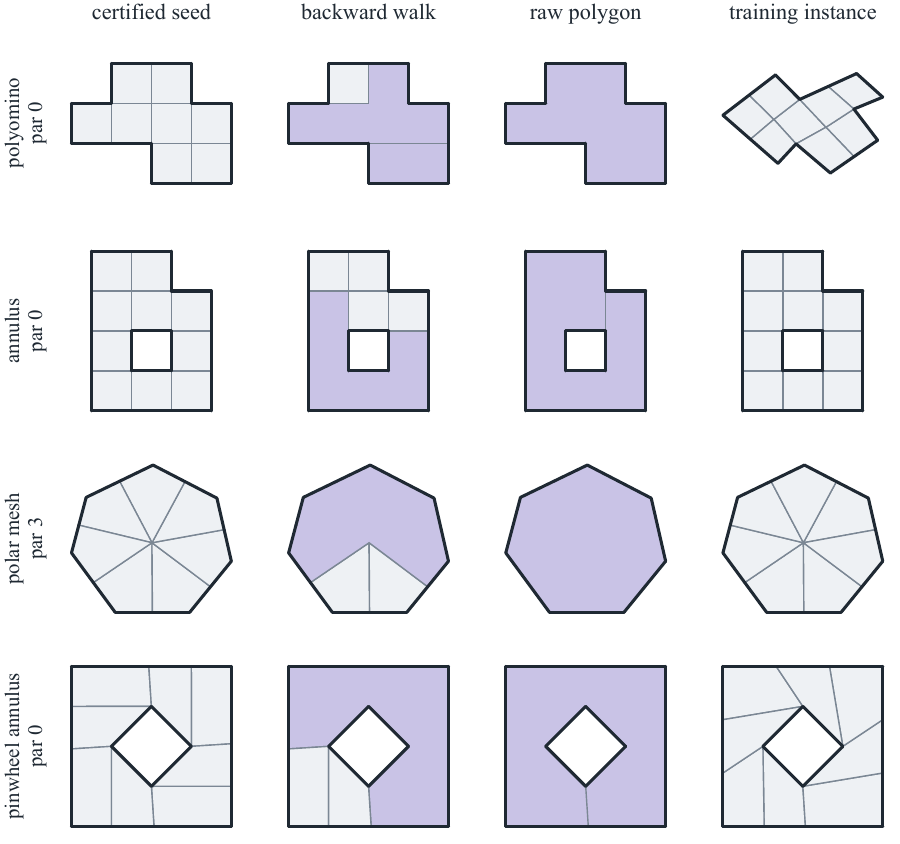
Some optimal meshes are easy to build: polyominoes, annuli, meshes around a hub. Undoing one edge at a time turns each into a sequence of the agent's own moves that ends at par, so behaviour cloning has unlimited, certified demonstrations.
Each row shows a constructed optimal mesh, a point part-way along the backward walk, the single face it starts from, and the instance the agent trains on.
Get started
Install
git clone https://github.com/ArjunNarayanan/par-quad.git
cd par-quad
python3.12 -m venv venv
venv/bin/pip install -r requirements.txt
The paper's domains come from geo2d, released soon. Until then export GEOGEN_PATH=tools/geo2d_lite runs everything on a stand-in generator whose domains differ from the paper's.
Mesh a domain with the released agent
venv/bin/python utilities/animate_rollout.py \
    -suite straight-holes -draw 10 -n 24 \
    -out out -name demo
Writes out/demo.mp4. The README covers the paper's evaluation, the Gmsh comparison, the curved repair search and training from scratch (about four hours on a laptop).
Can you beat the agent?
Play the agent's game in your browser: the same moves, the same bound. It solves every straight-sided level, but not every curved one.
Play now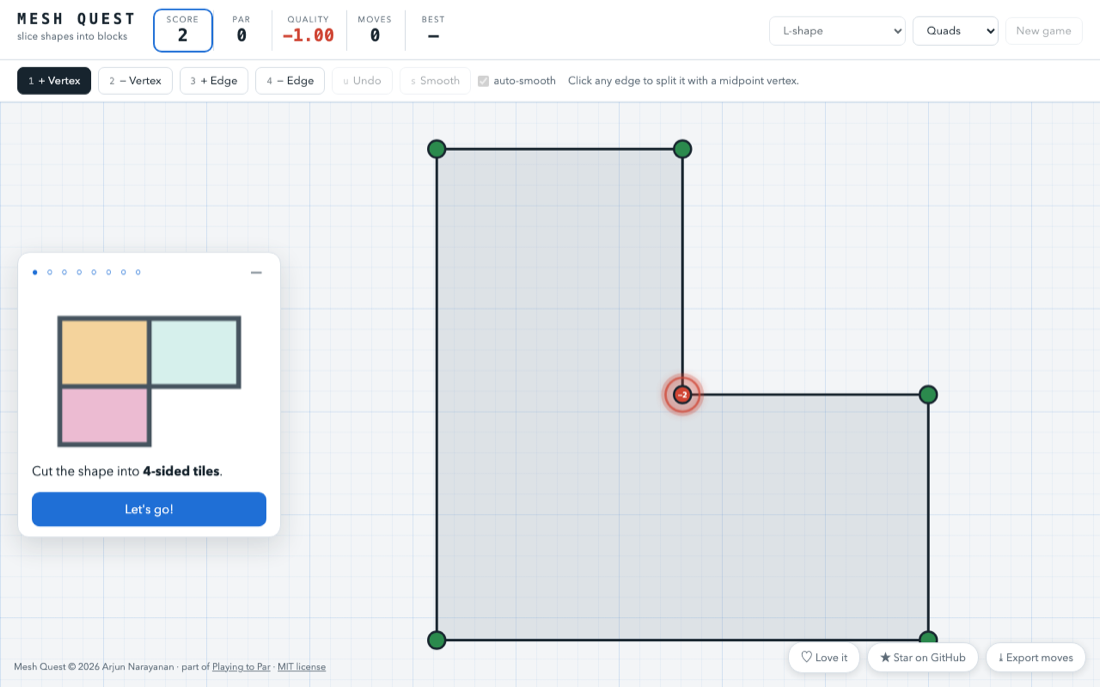
Cite this work
@article{narayanan2026playing,
  title   = {Playing to Par: Reinforcement Learning for Provably Optimal
             Quadrilateral Block Decompositions},
  author  = {Narayanan, Arjun and Persson, Per-Olof},
  journal = {arXiv preprint arXiv:2609.32146},
  year    = {2026}
}